

What is E-invoicing
E-invoicing FAQs
1. What is e-invoicing?
E-Invoicing means issuing invoices electronically in a standard digital format that’s sent automatically between the seller, buyer, and the Tax Authority for validation, replacing paper or PDF invoices.
Is this information helpful?
2. What is the difference between paper invoices and e-invoices?
Paper invoices are issued manually and require signatures and stamps. E-invoices are issued digitally, are electronically certified, and carry a unique verification code.
Also, the e-invoices are issued and sent to the buyer and the Tax Authority instantly. They are stored electronically with instant verification and reporting, which is ensuring speed, accuracy, and security.
Is this information helpful?
3. What is the main objective of e-invoicing?
The main objective of e-invoicing is to improve business transaction efficiency, ensure transparency and tax compliance, as well as prevent fraudulent invoices.
Is this information helpful?
4. What are the direct benefits for companies?
Direct benefits for companies include reduced operating costs, simplified auditing, improved data accuracy and inventory management, reduced errors, integration with company systems, secure archiving, and real-time reporting for better decision-making.
Is this information helpful?
5.What are the implementation phases and who are the target groups?
The system will be implemented in 4 phases, each targeting a specific group as follows:
Phase 1: One hundred large VAT-registered companies, implementation begins in August 2026.
Phase 2: All large VAT-registered companies, implementation begins in February 2027.
Phase 3: All remaining VAT-registered taxpayers, implementation begins in August 2027.
Phase 4: Government institutions and entities, implementation begins in February (year to be announced)
Is this information helpful?
6. How were these Taxpayers selected?
Based on criteria such as revenue size, annual invoice volume, and technical readiness.
Is this information helpful?
7. Will SMEs be included?
Yes, within the third phase of the project. Can a company not targeted in the first phase applies the system voluntarily? Yes, optional early adoption is allowed with necessary support provided.
Is this information helpful?
8. How is an e-invoice issued?
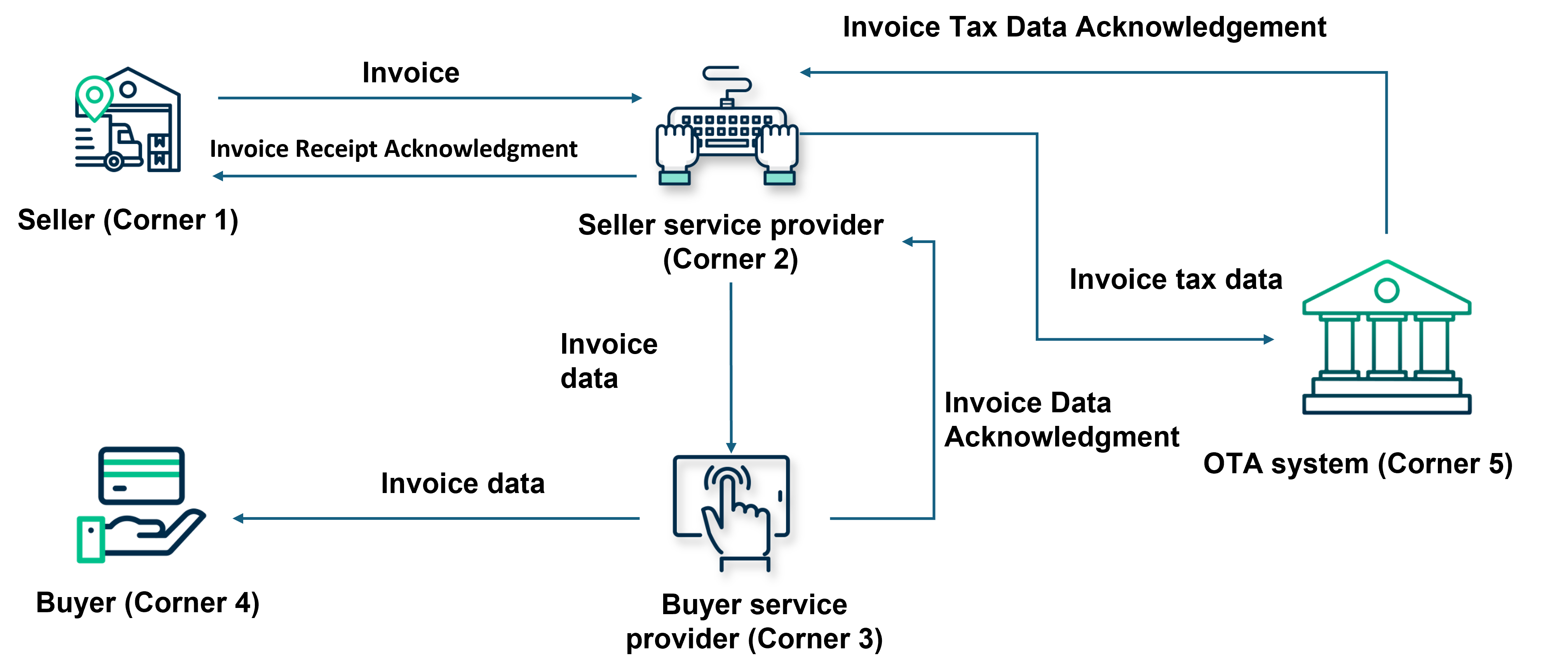
Invoices are issued through an electronic operating model linking taxpayers, service providers, tax system, and recipients to ensure secure and standardized issuance.
1. (Supplier)
2. (Supplier’s Service Provider)
3. (Buyer’s Service Provider)
4. (Buyer)
5. (Oman Tax Authority – OTA)
Is this information helpful?
9. Will paper invoices be canceled?
Yes, after official implementation, the electronic invoice will be the only legal document.
Is this information helpful?
10. Can invoices be issued manually then entered electronically?
No, invoices must be issued directly from the approved electronic system.
Is this information helpful?
11. Can an invoice be canceled or modified after issuance?
Yes, by issuing an electronic credit or debit notification.
Is this information helpful?
12. Will there be penalties for non-compliance?
Yes, penalties will be applied according to regulations, with a grace period before enforcement.
Is this information helpful?
13. Does the company need to change its current ERP system?
Not necessarily, integration is possible if it is compatible.
Is this information helpful?
14. Will the Tax Authority provide a free system?
Integration specifications will be provided for updating existing systems.
Is this information helpful?
15. What is the compatibility standard?
Invoice issuance in XML or PDF/A-3 format and API connectivity.
Is this information helpful?
16. Is a digital certificate required?
Yes, to ensure reliability and verification.
Is this information helpful?
17. Will companies receive training before implementation?
Yes, training workshops and practical system training will be provided.
Is this information helpful?
18. Will there be a trial period before enforcement?
Yes, the first phase will include 100 companies as pilots.
Is this information helpful?
19. How can technical support be obtained?
A technical support center and hotline will be established.
Is this information helpful?
20. Will a guidance manual be provided?
Yes, detailed guides and awareness materials will be provided.
Is this information helpful?
21. How will e-invoices be archived?
Invoices will be archived for 10 years (5 years in the system + 5 years in an electronic archive).
Is this information helpful?
22. Can companies access old invoices?
Yes, they can be easily retrieved.
Is this information helpful?
23. How will customers not ready for e-invoices be handled?
Issue electronically and provide a paper copy for display only.
Is this information helpful?
24. Can invoices be issued in two languages?
Yes, the system will support both Arabic and English.
Is this information helpful?
25. What is the role of the service provider?
In OTA’s 5-corner model for e-Invoicing, Service Providers (representing corners 2 and 3) are responsible to validate and exchange e-Invoices between Taxpayers (representing corners 1 and 4), while also reporting specific Tax data to OTA’s system (representing corner 5). In order to become a Service Provider, companies will need to apply for accreditation with OTA.
Is this information helpful?
26. Can companies act as their own service provider?
Yes, any company that meets the service provider criteria and passes OTA’s prescribed tests can be accredited and subsequently also serve as their own service provider.
Is this information helpful?
27. Should out-of-scope supplies be issued as e-invoices?
Issuing e-Invoices will not be mandatory for out-of-scope supplies. However, we recommend awaiting further clarification from the legislation to confirm this.
Is this information helpful?
28. If two companies belong to one VAT group, what VAT details appear for buyer and seller?
The same VAT number can be provided for both buyer and seller. The invoice will not be rejected.
Is this information helpful?
29. Do all companies under one VAT group need to follow e-invoicing?
Yes. All companies under the same tax group and sharing one tax number must follow the e-invoicing procedures and must have a single/same service provider.
More details will be provided in due course for VAT groups.
Is this information helpful?
30. What is the time allowed for submitting B2B and B2C e-Invoices?
• B2B: Real-time.
• B2C: Still under discussion and the decision will be announced soon.
Is this information helpful?
31. Will B2C follow real-time or batch?
There is no stipulated timeframe for B2C submission yet. Guidance will be provided later.
Is this information helpful?
32. Can invoices be cancelled?
No. Invoices cannot be cancelled. You must raise a credit note to adjust a previous invoice.
Is this information helpful?
33. If supplier sends invoice to wrong buyer/wrong VAT?
Issue a credit note for the wrong buyer and then issue a new invoice to the correct buyer.
Is this information helpful?
34. If the recipient is not VAT-registered and has no ASP, how does validation work?
This is considered as a B2C scenario involving the following:
• The seller must submit the invoice to its service provider (ASP).
• The seller’s service provider (ASP) needs to only submit the tax data to Corner 5 (OTA).
• The seller can exchange the human readable version of the invoice with the buyer using their existing mechanism outside of the Fawtara network (for example as a physical invoice, PDF invoice or other). Note that the human readable version will also need to be compliant with the specifications prescribed by OTA and will require a QR code allowing the buyer to validate the eInvoice. QR code details will be shared in due course.
Is this information helpful?
35. If seller not under e-invoicing, can the buyer claim VAT?
Scenario 1: If the seller is not a VAT registered Taxpayer (i.e. not meeting the VAT registration requirements)
All VAT registered Taxpayers will be under e-invoicing once all rollouts are completed. Accordingly, if a seller is not a VAT registered Taxpayer, they are not required to be part of Fawtara eInvoice network. Any invoices issued by such sellers is not allowed to collect VAT and accordingly there is no case for the buyer to claim VAT. Companies can report to OTA any cases of invoices received from non-VAT registered companies, if those invoices include VAT.
Scenario 2: If the seller is not part of the Fawtara e-Invoicing network yet (i.e. not part of current or previous rollouts)
If the seller is a VAT registered Taxpayer that is not part of the current or previous rollout, they can continue to issue invoices using their existing mechanism as long as such invoices are compliant with the VAT laws and regulations beyond e-Invoicing. Buyers receiving such invoices can claim VAT as per the eligibility requirements currently and will continue to file returns as currently.
Is this information helpful?
36. If invoice is not an e-invoice, can buyer claim VAT?
Once the e-Invoicing rollouts have commenced and before the conclusion of all rollouts, the only valid scenario where a buyer can claim input VAT on an invoice that is not an e-invoice is covered in scenario 2 in the response to Question 11 above.
After all rollouts have concluded and all Taxpayers have integrated with the Fawtara network, all invoices must be e-invoices in order for a buyer to claim input VAT.
Is this information helpful?
37. Will the Tax Authority provide mapping guidance?
The shared draft e-Invoicing data dictionary and business rules provide the necessary mapping guides for ERPs and other billing systems.
Please note that the current version shared is a draft version for consultation with Rollout 1 Taxpayers and interested prospective service providers.
OTA will confirm and release a final and official version soon after taking into consideration any feedback received from its consultation sessions with the above mentioned groups.
Is this information helpful?
38. Are mandatory fields fully defined?
Yes. Mandatory, optional and conditional requirements are defined in the Data Dictionary and Business Rules. Please note that the current version shared is a draft version for consultation with Rollout 1 Taxpayers and interested prospective service providers. OTA will confirm and release a final and official version soon after taking into consideration any feedback received from its consultation sessions with the above mentioned groups.
Is this information helpful?